Bitcoin ETF vs Buying Bitcoin: Fees, Custody and Taxes Compared
A spot bitcoin ETF is the better fit if you want bitcoin's price exposure inside a brokerage or retirement account and never want to manage keys; buying bitcoin directly is the better fit if you want to own the coins themselves, move them, or hold for many years at no yearly fee. The fee gap is smaller than most people assume: at a 0.25% sponsor fee, an ETF costs about $25 a year on $10,000, and on our worked example it only overtakes a one-off exchange fee after about six years. If you are trying to decide whether to buy bitcoin at all, this page will not settle that; it compares two ways of holding it, using fees read on 9 October 2026.
The short answer: it depends on custody and account type
Two questions decide most cases. First, where will the money sit? If it is an IRA or a workplace-linked brokerage account, an ETF is usually the only practical way in, because ordinary retirement accounts hold securities, not coins. Second, do you want the bitcoin itself? If you want to send it, spend it, or keep it in a wallet nobody else controls, only buying directly gives you that. An ETF share is a claim on a fund, not a coin.
If neither question pushes you one way, compare cost over your time horizon and how you feel about holding keys. Short horizons and nervous key-holders lean ETF. Long horizons and a willingness to learn self-custody lean direct.
| Spot bitcoin ETF | Buying bitcoin directly | |
|---|---|---|
| What you own | Shares in a fund that holds bitcoin | Bitcoin itself |
| Ongoing cost | Sponsor fee 0.15%–0.25%/yr (GBTC 1.50%) | No yearly fee; trading fees when you buy and sell |
| Withdraw as coins | No (in-kind is for authorised participants only) | Yes, to any wallet |
| When you can trade | Stock-market hours | Any time, 24/7 |
| Who holds the bitcoin | The fund's custodian | The exchange, or you once withdrawn |
| IRA-friendly | Yes, at most brokers | Only via specialist crypto IRAs |
| Tax paperwork | Standard brokerage forms | Form 1099-DA from US brokers; your own records for wallets |
How spot bitcoin ETFs hold bitcoin
The SEC approved the listing and trading of spot bitcoin exchange-traded products on 10 January 2024. Each fund buys bitcoin and keeps it with a custodian; the shares you buy through a broker track the value of that bitcoin, minus the fund's yearly fee. When demand for shares rises, large firms called authorised participants create new shares; when it falls, they redeem them.
Since 29 July 2025, the SEC has allowed those creations and redemptions to happen in kind, meaning in bitcoin rather than cash. That matters for how efficiently the funds run, but it does not change what you can do as a retail holder. You still buy and sell shares for dollars through your broker. You cannot hand in your shares and receive bitcoin.
Scale is not the issue it was in 2024. BlackRock's iShares Bitcoin Trust (IBIT) reported net assets of about $65.69 billion as of 8 October 2026. Size does not make a fund safer from bitcoin's price swings; it mainly means the shares trade with plenty of buyers and sellers during market hours.
Cost over time: expense ratio vs trading and withdrawal fees
An ETF charges a small percentage every year. Buying bitcoin directly charges a fee when you buy and again when you sell, and nothing in between unless you move the coins. That difference in shape is what decides which is cheaper for you.
The yearly sponsor fees, read from each issuer's page or SEC filing on 9 October 2026:
- Grayscale Bitcoin Mini Trust (BTC): 0.15%
- Bitwise Bitcoin ETF (BITB): 0.20%
- ARK 21Shares Bitcoin ETF (ARKB): 0.21%
- iShares Bitcoin Trust (IBIT) and Fidelity Wise Origin Bitcoin Fund (FBTC): 0.25%
- Grayscale Bitcoin Trust (GBTC): 1.50%, roughly six to ten times the others
For the direct route we use Kraken Pro, because its fee schedule is published and readable: at the entry tier, a market (taker) order costs 0.80% and a limit (maker) order 0.40%, falling with 30-day volume. Kraken's simple app charges 1% plus a spread, so the order-book screen is the cheaper door.
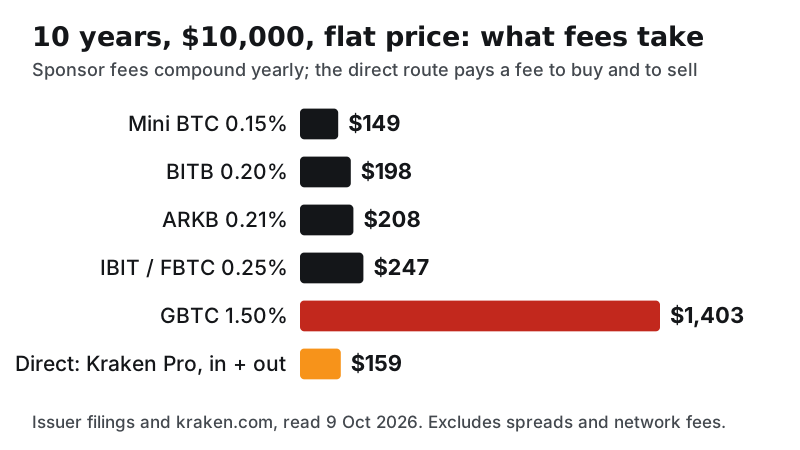
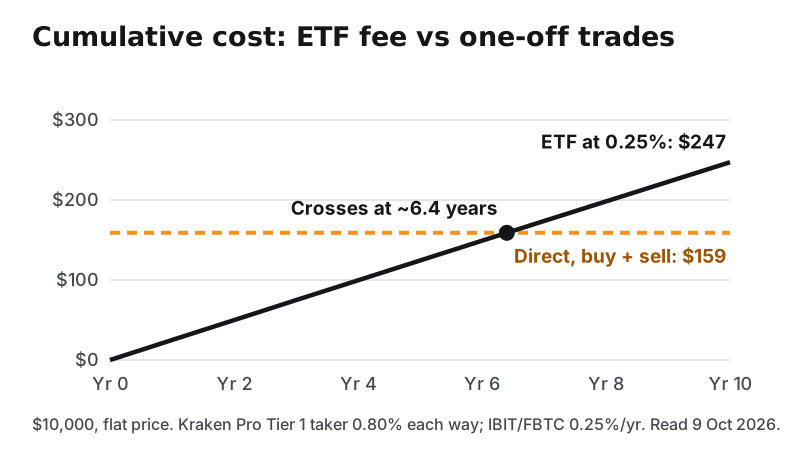
Here is the arithmetic. Put $10,000 in and assume, purely to isolate fees, that bitcoin's price does not move. A 0.25% fund takes about $25 in year one, $124 by year five and $247 by year ten. GBTC at 1.50% takes about $1,403 over ten years. Buying $10,000 on Kraken Pro with a 0.80% market order costs $80; selling the remaining $9,920 later costs about $79, so roughly $159 in total, whenever you sell.
The two lines cross at about 6.4 years for a 0.25% fund and about 10.7 years for the 0.15% Mini Trust. Hold for less than that and the ETF's yearly fee is the cheaper deal; hold for longer and the one-off trading fees win. Use limit orders at 0.40% and the direct route gets cheaper still. If the price rises, both costs rise in dollars, because both are percentages of what you hold.
Two costs sit outside both figures. ETF shares trade with a small bid-ask spread and possibly a broker commission. Direct buyers pay a network fee to move coins to their own wallet, and many will buy a hardware wallet once. Neither changes the shape of the result, but both are worth checking on your own broker or exchange before you decide.
Cheaper direct buying: an order-book exchange such as Kraken
If the cost comparison pushes you toward owning the coins, the cheapest habit is the same on any reputable exchange: fund by bank transfer, use the order-book screen rather than the one-tap buy, and place a limit order when you are not in a hurry. On Kraken Pro that means 0.40% instead of 0.80% at the entry tier. One detail trips people up: on Kraken, ACH deposits can be traded straight away, yet crypto bought with them stays put for seven days, so allow a week before withdrawing to your wallet. Our step-by-step guide walks through each setting.
Affiliate link. We may earn a commission — it never moves a ranking.
Custody and control
With an ETF, three parties stand between you and the bitcoin: your broker holds your shares, the fund owns the coins, and a custodian stores them. You never handle a private key, which removes the risk of losing one, and you also never get to move the bitcoin. If the fund closes, you receive cash, not coins.
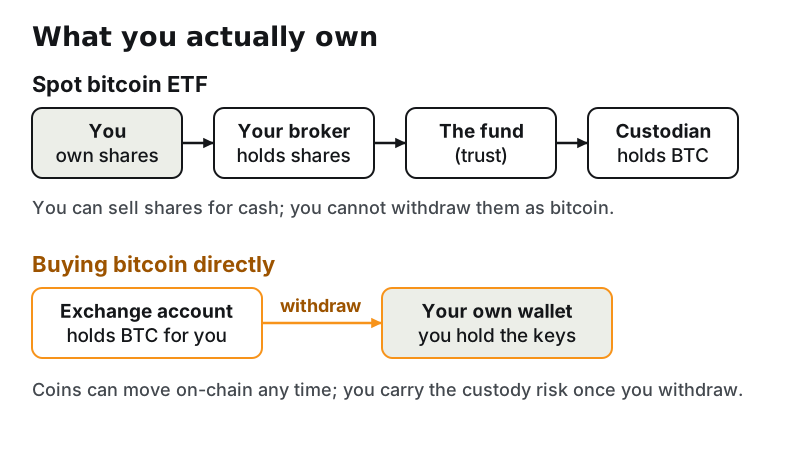
Buying directly flips that. While your bitcoin sits on an exchange, the exchange holds it for you, and its failure or freeze becomes your problem. Once you withdraw it to your own wallet, nobody can freeze it, and nobody can recover it if you lose the backup. That trade-off is the core of storing your bitcoin safely, and it is the main reason some long-term holders accept the work of self-custody.
Holding it yourself: a hardware wallet such as Ledger
If you go direct and plan to hold for years, a hardware wallet keeps the keys offline. It is a one-off purchase; On 10 October 2026 Trezor listed its entry Safe 3 at $59 and Ledger its Nano S Plus at $69, roughly two to three years of a 0.25% ETF fee on $10,000. That makes it a natural fit for the long-horizon case where direct buying already wins on fees. Write the recovery phrase on paper, store it where only you can reach it, and never type it into a website or app that asks for it, whatever reason they give.
Affiliate link. We may earn a commission — it never moves a ranking.
Taxes and IRAs
For US federal tax, the IRS treats bitcoin as property. Selling, swapping or spending it is a taxable event, reported on Form 8949. From 2025, US brokers send Form 1099-DA showing your gross proceeds, and from 2026 they add cost basis for certain sales. Coins you moved in from your own wallet will often show no basis on that form, so keep your own purchase records. ETF shares are securities, so your broker reports their sale the way it reports any fund sale.
Retirement accounts are where ETFs are most useful. You can buy ETF shares inside a regular IRA at most brokers, up to the 2026 contribution limit of $7,500, or $8,600 if you are 50 or older. Holding bitcoin itself in an IRA needs a specialist provider, and the fees differ sharply. Fidelity's Crypto IRA charges no account or custody fee but a 1% trading fee on each buy and sell, and is not offered in every state. Bitcoin IRA's fee page shows 2% on every buy or sell, and its monthly custody charge is 0.08% of your balance, never less than $20. Next to a 0.15%–0.25% ETF, those are expensive ways to get the same exposure.
None of this is tax advice. Rules depend on your situation; check with a tax professional before you act.
Liquidity and trading hours
Bitcoin trades around the clock, every day of the year. ETF shares trade only when US stock markets are open. If bitcoin falls sharply on a Saturday, an ETF holder can do nothing until Monday's open, and the shares may open well below Friday's close. Direct holders can act at any hour, which is a benefit only if you are disciplined enough not to trade on every swing.
During market hours, large ETFs trade with tight spreads because so many buyers and sellers use them. Direct buyers face a spread too, and on simple-buy screens it is often wider than the order book's.
Edge cases and what can go wrong
- You picked a high-fee fund by accident. GBTC charges 1.50% a year. Check the expense ratio, not just the word "bitcoin" in the name.
- You need to send bitcoin to someone. An ETF cannot do it. You would have to sell the shares, buy bitcoin and pay both sets of costs.
- Your exchange fails while holding your coins. That risk only exists while coins are on the platform. Withdraw long-term holdings to your own wallet.
- You lose your recovery phrase. With self-custody, nobody can restore it. ETF holders do not face this risk at all.
- You confuse an ETF with a futures fund. Some older bitcoin funds hold futures, not bitcoin, and behave differently. Check the fund's description for "spot".
- You expect the ETF to protect you. It tracks bitcoin's price down as well as up, and it can lose most of its value if bitcoin does.
Which to choose
Choose an ETF if the money lives in an IRA or brokerage account, if your horizon is short, or if you simply do not want to manage keys. Pick a low-fee spot fund; the gap between 0.15% and 1.50% is worth far more than any brand.
Choose to buy bitcoin directly if you want the coins themselves, expect to hold for many years, or want to move them. Buy through an order-book exchange, withdraw to a wallet you control, and keep good records. The full walk-through is in our guide to buying bitcoin safely.
Bitcoin ETF vs bitcoin: quick answers
Is it better to buy a bitcoin ETF or bitcoin?
What do spot bitcoin ETFs cost?
Can I turn bitcoin ETF shares into real bitcoin?
How do I buy a bitcoin ETF in a Roth IRA?
Is a bitcoin ETF safer than owning bitcoin?
New here? Start with the full step-by-step guide to buying bitcoin safely, or learn how to sell bitcoin and cash out.