Cheapest Place to Buy Bitcoin (2026): All-In Costs Compared
The cheapest place to buy bitcoin is usually an exchange order book funded by a free bank transfer. On the fee schedules we read on 9 Oct 2026, a $1,000 market order cost $8 at Kraken Pro's entry tier, $12 on Gemini ActiveTrader and 20 cents on Binance.US, against roughly $28 through PayPal and up to $45 through a card on-ramp such as MoonPay. For small regular purchases, Cash App's Auto Invest charges no fee and no spread at all.
Price alone is the wrong test, though. A route only counts as cheap if you can also move the bitcoin to a wallet you control without a large fee, a long hold or a minimum you cannot reach. This page adds up the three costs of a purchase for a $100 and a $1,000 buy, shows what each provider charges to withdraw, and flags the routes that look cheap but keep your coins locked in. It is for US buyers; fees elsewhere differ.
Short answer: where it costs least
If you are buying once, fund an exchange account by ACH and place your own order on the exchange's trading screen rather than pressing a simple Buy button. A limit order that waits on the book pays the maker rate, which was 0.40% at Kraken Pro and 0.60% at Gemini ActiveTrader on 9 Oct 2026. If you buy a small amount every week or month, a recurring plan with no fee and no spread, like Cash App's Auto Invest, beats any per-trade fee. And if you only want bitcoin's price movement in a brokerage account or IRA, a spot bitcoin ETF costs 0.15% to 0.25% a year, but you never hold the coins.
The most expensive common routes are debit and credit card purchases, PayPal, simple instant-buy buttons with an unpublished spread, and bitcoin ATMs, where state fee caps run as high as 18%. Our how to buy bitcoin guide walks through the first purchase step by step; this page is only about cost.
The three costs: fee, spread, withdrawal
Every bitcoin purchase has up to three costs, and providers tend to advertise whichever one is smallest. The fee is the visible charge, either a percentage or a flat amount. The spread is the gap between the market price and the price you are quoted; it is built into the rate, so you never see it itemised. The withdrawal cost is what you pay to move the bitcoin off the platform, which includes the network fee and sometimes a platform charge or a minimum amount.
Some services trade one cost for another. Robinhood takes no commission on orders sent through its default routing, yet its order-routing page said it earned roughly 95 cents for every $100 of orders via the spread (as of 15 Jun 2026). Gemini's fee page, read 12 Oct 2026, says a spread is included in Instant and Recurring orders on top of a fee it calculates when you order. Kraken's app charges 1% on instant buys and says the quoted price also includes a spread, without publishing its size. Order-book trading on Kraken Pro, Gemini ActiveTrader or Binance.US replaces the markup with a published maker or taker fee, which is why it is cheaper.
A $100 buy and a $1,000 buy, compared
The table applies each provider's published US fees to the same two purchases. Where a provider publishes a range or a maximum, we show it; where it does not publish its spread, we say so instead of guessing. Card and PayPal deposit fees are excluded unless the row says otherwise.
| Route | What it charges | $100 buy | $1,000 buy |
|---|---|---|---|
| Cash App Auto Invest | 0% fee, 0% spread on recurring buys | $0 | $0 |
| Binance.US (order book, ACH) | 0% maker, 0.02% taker | $0 to $0.02 | $0 to $0.20 |
| Kraken Pro (ACH) | 0.40% maker, 0.80% taker at entry tier | $0.40 to $0.80 | $4.00 to $8.00 |
| Gemini ActiveTrader (ACH) | 0.60% maker, 1.20% taker at entry tier | $0.60 to $1.20 | $6.00 to $12.00 |
| Robinhood | No commission; spread (its example: $0.95 per $100) | about $0.95 | about $9.50 |
| Kraken app instant buy | 1% fee plus an unpublished spread | $1.00 + spread | $10.00 + spread |
| Cash App market buy | 2.0% under $500, 0.9% at $1,000 to $1,999, plus 0% to 0.75% spread | $2.00 to $2.75 | $9.00 to $16.50 |
| Uphold | Typical BTC spread 2.05% to 2.2% | $2.05 to $2.20 | $20.50 to $22.00 |
| PayPal | 2.00% ($75 to $200) or 1.80% ($200.01 to $1,000) plus about 1% estimated spread | about $3.00 | about $28.00 |
| MoonPay | Up to 4.5% (minimum fee up to $3.99) plus spread and network fee | up to $4.50 + spread | up to $45.00 + spread |
| Bitcoin ATM, California | Capped at the greater of $5 or 15% | up to $15 | up to $150 |
| Spot bitcoin ETF | 0.15% to 0.25% a year; no coins to withdraw | $0.15 to $0.25 a year | $1.50 to $2.50 a year |
Coinbase is missing from the numbers because it does not publish its simple-trade spread or a fixed fee table; it shows both on the order preview before you confirm. Its Coinbase One membership removes trading fees on up to $500 a month for $4.99 a month (Basic tier, read 10 Oct 2026), though the spread still applies. If you already pay for Coinbase One, small buys inside that cap cost only the spread; you can compare Coinbase One's tiers on its own page.
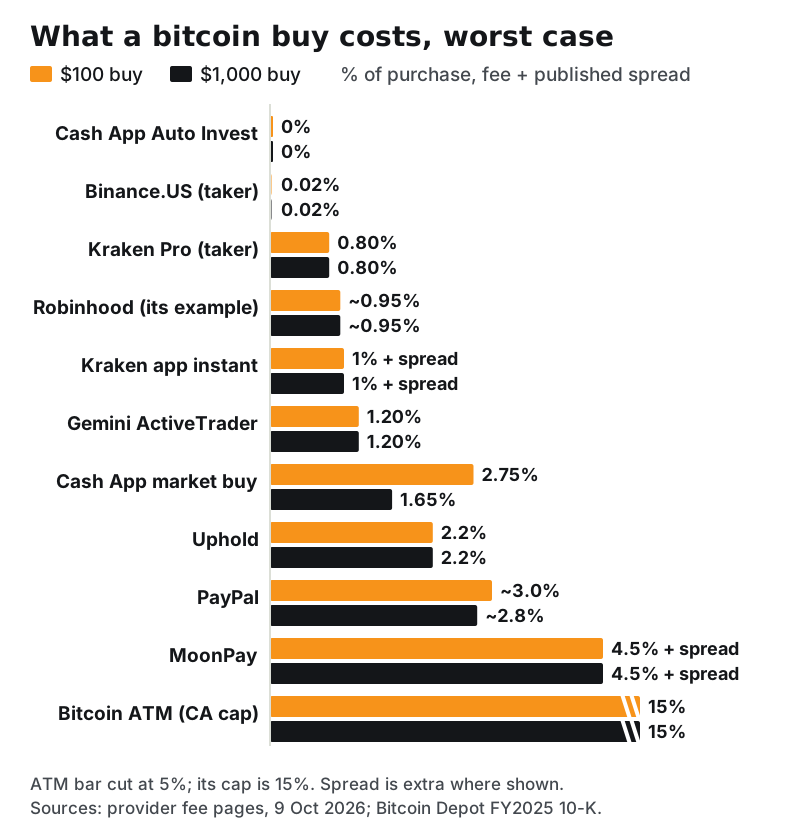
Two patterns stand out. First, the gap between order-book trading and convenience apps is large: the same $1,000 costs $8 or less on Kraken Pro and about $28 through PayPal. Second, percentage ladders punish small buys. Cash App's 2.0% fee on a $100 market buy falls to 0.9% at $1,000 and to zero above $2,000, and PayPal's tiers fall from 2.20% under $75 to 1.50% above $1,000.
Where $1,000 changes the answer
At $1,000, flat minimums stop mattering and percentage tiers start to drop. Cash App is the clearest case: a buy of exactly $1,000 costs up to $16.50, but a buy over $2,000 carries no fee and no spread, so two buys of $1,000 cost more than one of $2,001. MoonPay's minimum fee of up to $3.99 is a large share of a $50 purchase but irrelevant at $1,000, where its percentage fee of up to 4.5% does the damage.
Order-book fees also fall with volume. Kraken Pro drops to 0.30% maker and 0.60% taker once your 30-day volume passes $2,500, and Gemini ActiveTrader drops to 0.40% and 0.80% from $10,000. One catch on Kraken: its fee schedule says instant-buy volume does not count toward those Pro tiers. For a one-off $1,000 buy where you want low cost and a clean route to your own wallet, Kraken Pro funded by ACH is the cheapest option among our partners on 9 Oct 2026 prices.
Cheapest by payment method
How you pay can cost more than the trade. On the fee pages we read on 9 Oct 2026 (Gemini's on 12 Oct), ACH bank transfers were free at Kraken, Gemini and Binance.US. Debit cards were not: Kraken charges $0.25 plus 3.75% on card deposits, Gemini 3.49% and Binance.US 3.99%, before any trading fee. Gemini also charges 2.50% on PayPal deposits. On a $100 purchase, Kraken's card fee alone comes to $4.00; on $1,000 it is $37.75.
Card and PayPal funding also slows your exit. Kraken puts a 72-hour withdrawal hold on purchases funded by card, PayPal or a phone wallet such as Apple Pay or Google Pay, and says every US card purchase may be held, not only your first. Credit cards add another risk: some card issuers treat crypto purchases as cash advances, with a fee and interest from day one. Our debit and credit card guide covers that in detail. Wire transfers are free to send in at Kraken, Gemini and Binance.US, but Gemini and Binance.US charge $25 to wire money back out.
When speed matters more than cost, card-first on-ramps are built for it. Paybis advertises no Paybis fee on a first purchase (the network fee still applies), and its service fee otherwise varies with a typical $2 minimum; Paybis and MoonPay both show the final amount before you confirm. Read that figure, not the headline rate.
Recurring buys
If you plan to buy every week or month, the per-purchase fee matters more than any single trade. Cash App charges no fee and no spread on scheduled Auto Invest buys, Round Ups and direct-deposit bitcoin, which makes it the cheapest scheduled route we found for small amounts. Robinhood lets recurring buys start from $1 with no commission, so the cost is its spread. Kraken's app charges 1% on recurring buys, plus spread, unless you pay for Kraken+, which waives trading fees on the first $10,000 of app purchases each month; Kraken does not show the membership price on its fee page.
For a scheduled plan, check two numbers before you start: the cost per purchase as a percentage of your usual amount, and the minimum you need to withdraw. A $25 weekly buy at 1% plus spread costs at least $13 a year, which is small, but after a few months you may still be below a withdrawal minimum such as Cash App's 100,000 sats for free standard withdrawals.
Cheap but you can't withdraw: the trap
A low purchase price is only half the cost if getting the bitcoin out is slow, expensive or impossible. Spot bitcoin ETFs are the extreme case: the yearly fee is tiny, but you own fund shares, not coins, and cannot send anything to a wallet. Elsewhere, the catches are holds and minimums.
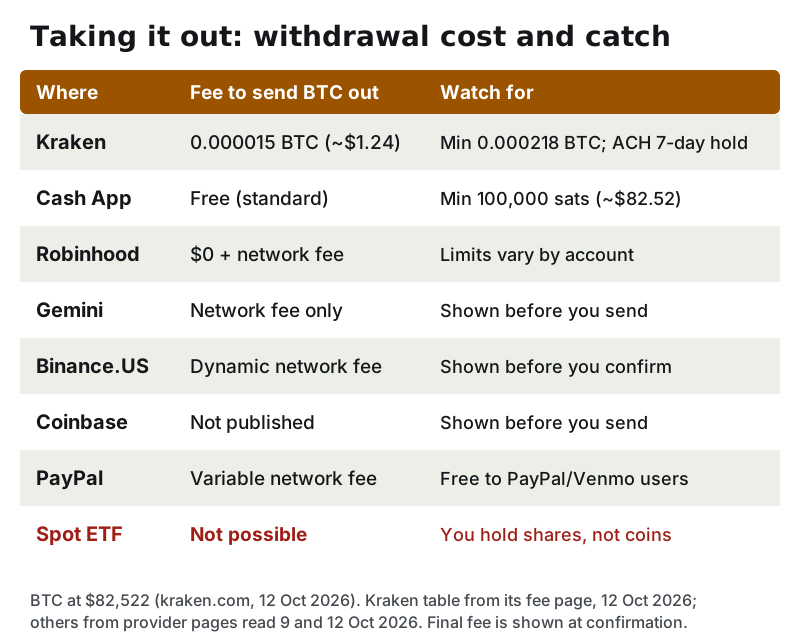
Kraken's ACH deposits are available to trade almost instantly but come with a seven-day withdrawal hold, so a buy on Monday cannot leave the exchange until the following Monday. Cash App will not let you withdraw bitcoin bought with money from an external bank until that transfer settles. Minimums matter for small balances: at Kraken the on-chain minimum was 0.000218 BTC including the fee, about $18 at the $82,522 price Kraken showed on 12 Oct 2026, while Cash App's free standard withdrawal needs 100,000 sats, about $82.52.
The rule we use is simple: the cheapest provider is the cheapest one that lets you withdraw to your own wallet when you want. If self-custody is your plan, read our guide to storing your bitcoin safely before you choose where to buy, and check the minimum withdrawal against the amount you intend to buy.
Bitcoin IRA fees compared
Buying bitcoin inside a retirement account adds a custody layer and usually a higher fee. As displayed on 9 Oct 2026, Bitcoin IRA charged 2% per buy or sell plus a custody fee of 0.08% of assets a month, with a $20 monthly minimum. On a $1,000 balance that minimum dominates: $20 to buy, then $240 a year in custody, about 24% of the balance. The minimum stops binding only at $25,000, where 0.08% equals $20.
Alternatives cost less. iTrustCapital showed a 1% fee per crypto transaction with no monthly or annual fee, and Fidelity's Crypto IRA charged a 1% trading fee with no fees to open, maintain or hold the account, on 9 Oct 2026. A spot bitcoin ETF bought in an ordinary IRA costs 0.15% to 0.25% a year, plus any broker commission, but holds fund shares rather than coins. The IRA contribution limit for 2026 is $7,500 ($8,600 at age 50 and up).
Bitcoin ATM fees
Bitcoin ATMs are the costliest mainstream way to buy. Bitcoin Depot, which ran about 9,700 machines at the end of 2025, describes the pricing at its machines as carrying a 'higher markup' in its annual filing, without publishing one percentage. The same report summarises state caps: California limits charges to the greater of $5 or 15%, Arkansas the greater of $5 or 18%, Illinois and Nebraska 18%, Connecticut and Oklahoma 15%, and Maine the greater of $5 or 3%, while Missouri sets no specific limit. Minnesota banned crypto kiosks from 1 Aug 2026.
ATMs are also where many scams end. The FBI's IC3 recorded 13,460 complaints and $389 million in losses involving crypto ATMs and kiosks in 2025. If someone tells you to deposit cash into a bitcoin ATM, stop. Our bitcoin ATM explainer covers the machines and state rules in more depth, and our bitcoin scams guide covers the scripts scammers use.
Edge cases
- You live in New York. Not every provider serves New York. Coinbase, Gemini, Robinhood Crypto, PayPal and Block (Cash App) appear on the NYDFS list of licensed virtual-currency firms; Kraken does not (checked 9 Oct 2026).
- Your buy is just under a fee tier. Cash App's fee drops to zero above $2,000 and PayPal's to 1.50% above $1,000; check whether a slightly larger single buy costs less in total.
- You use a market order on a thin book. The taker fee is published, but the price you get can move; a limit order fixes the price and pays the lower maker fee.
- You hold only a few dollars of bitcoin. Withdrawal minimums can trap small balances; see our page on buying partial bitcoin.
- You sell later. Selling costs fees too, and the IRS treats bitcoin as property, so a sale can create a taxable gain. See how to sell bitcoin.
Risks and what can go wrong
Lower fees do not reduce bitcoin's market risk. The price can fall hard and stay down, and money you cannot afford to lose does not belong in it. Exchanges can freeze withdrawals or fail, as several lenders and exchanges did in 2022, so fees are only one part of choosing where to buy; licensing, custody and withdrawal access matter as much. Fee schedules change without much notice, so recheck the provider's own fee page on the day you buy. Nothing here is a promise of any return.
Cheapest place to buy bitcoin: FAQ
What is the cheapest place to buy bitcoin?
How much does it cost to buy bitcoin, all in?
How can I buy bitcoin without fees?
What are bitcoin ATM fees?
Is a bitcoin ETF cheaper than buying bitcoin?
New here? Start with the full step-by-step guide to buying bitcoin safely, or learn how to sell bitcoin and cash out.